Pages

Showing posts with label Philippine. Show all posts

Filipinos celebrate as Pacquiao avenges loss

Sunday, 13 April 2014

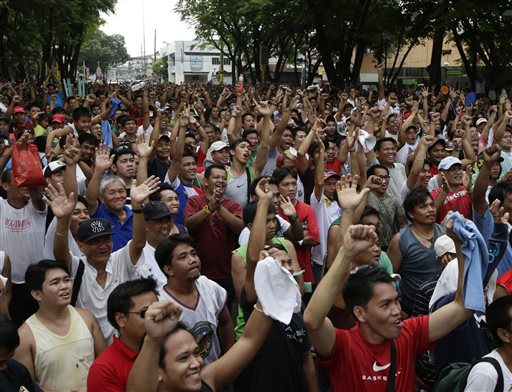
Filipinos cheer as they watch the WBO World Welterweight championship boxing match between the Philippines’ Manny Pacquiao and American Timothy Bradley at The MGM Grand Garden Arena in Las Vegas, live via satellite at Marikina city, east of Manila, Philippines on Palm Sunday, April 13, 2014. AP
“Manny is still the eighth wonder of the world,” Fr. Joey Faller said as Filipinos jumped from their seats, raised their arms and burst into cheers after the country’s boxing hero, Manny Pacquiao, regained his WBO welterweight title from American Timothy Bradley Jr. in a unanimous 12-round decision in Las Vegas on Sunday.
“Manny has proven that he is the better fighter. He still has the speed, the great footwork and the tsunami of punches,” said Faller, administrator of the Kamay ni Hesus (Hand of Jesus) shrine in Lucban town, Quezon province.
But he noticed something in the way Pacquiao, who has won world titles in eight boxing divisions, fought Bradley and he did not hesitate to say it.
“What he lacks now is the killer instinct,” Faller said. “He is so compassionate and not the Pacquiao we saw in the past. Probably his being born again Christian mellowed down his aggressiveness.”
But it’s not yet time for Pacquiao, 35, to quit boxing, the priest said.
“There is one unfinished business for him—to fight (Floyd) Mayweather (Jr.) for a one mega ultimate fight of the century,” Faller said, referring to the current World Boxing Council (WBC) welterweight champion, WBC and World Boxing Association (WBA) superwelterweight champion.
That is probably still in the cards, with Pacquiao saying he’s still good for another two years.
Cheers from colleagues
Among those who cheered Pacquiao’s victory over Bradley on Sunday were his colleagues in the House of Representatives.
Speaker Feliciano Belmonte Jr. said the Sarangani representative’s reclaiming his welterweight championship belt this late in his career showed that discipline and determination would always trump adversity.
“At 35, [Manny Pacquiao’s] victory over a much younger Bradley (30), who was said to have been even better trained now than in their previous fight, has shown the world that he continues to be the pound-for-pound King of Boxing,” Belmonte said in a statement.
Not so exciting
In the covered court at Bernardo Park in Quezon City, PO1 Conrad Lim did not find the fight too exciting, noting that Pacquiao was in good fighting condition but Bradley was not.
Still, Lim said he was happy that Pacquiao won. “He has proven that he still has [many] years as a fighter in him,” he said.
In the covered court in San Lorenzo village in Makati City, the crowd erupted in cheers every time Pacquiao had Bradley in a corner, raining punches on the American.
Even foreign residents of the village were seen cheering for Pacquiao.
“I’m a massive fan of Pacquiao. I even have posters of him all over my house,” said Marc Zanetta, a British national working at the UK Embassy in Taguig City.
Accompanied by a fellow British citizen, Zanetta said he always made it a point to see Pacquiao’s fights.
“I saw the previous fight (with Bradley). Although I think he won that one, this time he was faster. He was better. He was an experienced boxer and he wasn’t intimidated with Bradley’s antics. I am happy with the results,” Zanetta said.
“He was still slower but this is still exciting,” Alberto Kwong, 70, said, referring to Pacquiao. “He has shown once again that he is a champion.”
Suspense in Tondo
At the Tondo Sports Complex in Manila, the crowd fell silent during the fifth and sixth rounds, which were obviously dominated by Bradley.
“He’s losing,” someone in the crowd said, referring to Pacquiao, who was taking big blows from Bradley. “He should retire.”
But Pacquiao came back in the seventh round with his trademark rapid combinations, staggering Bradley at one point.
And the sports complex exploded in cheers after the score was announced.
Manila Mayor Joseph Estrada had been expected to watch the fight in the sports complex, but did not show up.
Vice Mayor Francisco “Isko” Domagoso joined hundreds of boxing fans at the San Andres Sports Complex and cheered with them after Pacquiao was announced the winner.
“Long live, Manny! You made us Filipinos proud again,” Domagoso later tweeted in Filipino.
More than 2,000 people endured the midday heat at the Navotas City Sports Complex and cheered Pacquiao on as the Filipino pressured his American opponent.
“Yes, that’s it,” they cried as Pacquiao staggered Bradley with a left to the head.
“In their first fight, Manny was cheated,” an old man said after the score was announced. “But this time, [he’s the clear winner].”
30-km walk
In Pampanga province, Ben Lampa, a village watchman in Pulong Santol, did not wait for the end of the fight and declared Pacquiao the “winner in round 10.”
Resident Domingo Ponce said Pacquiao “did everything he could to win.”
Nimfa Ferrer, a housewife, said she was happy for Pacquiao even though he did not knock out Bradley.
Fifty Aeta people walked for two hours to Sapang Bato village in Angeles City, 30 kilometers from their own village, to watch the fight.
“[Pacquiao is] our idol,” Roman King, one of them, said. “We want to see him [fight].”
They were not disappointed, as Pacquiao gave them what international boxing referee Bruce McTavish described as a “smart fight.” But McTavish said he was not sure how long Pacquiao would have power in his punches to stay in business.
Traffic in Baguio
In Baguio City, traffic slowed down as early as 10 a.m. on Naguilian and Abanao roads because of the big crowds of people who turned out for the free public viewing of the fight.
The crowds broke into cheers after Pacquiao was announced the winner at about 1 p.m.
In Nueva Ecija province, commuters in the Science City of Muñoz complained about the lack of tricycles to ferry them to their destinations. The tricycle drivers took time out to watch the fight on television at barber shops and other public places.
Ireneo Bucsit Jr., 27, a teacher at Muñoz National High School, said Pacquiao proved he was sharper than Bradley despite his age.
“It was sweet revenge for Pacquiao,” he said.
Mayor Adrienne Cuevas said the fight reaffirmed Pacquiao’s brand of heroism that every Filipino should emulate.
“He showed the virtue of working hard for a great cause,” Cuevas said.
In Bataan province, businessman Bong Talastas, 58, of Balanga City, was unconvinced that Pacquiao gave his all.
“It seems that somebody is controlling his moves to prevent Bradley from being knocked out. For the benefit of the orchestrator, the [farce] must go on,” he said.
Storm survivors happy
In communities in the Visayas ravaged by Yolanda on Nov. 8, storm survivors rejoiced at Pacquiao’s victory over Bradley.
“Of course, I am happy to see him win again and somehow I will go home to our tent happy and contented,” said Florencio Villanuna, 77, whose family lost their home in San Jose district in Tacloban City.
“He is really the best fighter today,” Villanuna said after Pacquiao was declared the winner of the fight.
In the island village of Malangabang in Concepcion town, Iloilo province, fishermen did not go to sea to watch the fight.
“We are all happy that Pacquiao won. We are also slowly recovering despite the damage to our houses,” village councilor Sonny Ciriaco said.
In Tagbilaran City, Bohol province, village gyms erupted in cheers after Pacquiao’s victory over Bradley was announced.
“It was exciting. There were no knockdowns, but that’s OK. We got the victory,” said Mayor John Geesnell Yap, whose administration sponsored the public viewing of the fight in 15 villages.
Supt. Joie Yape, spokesperson for the Bohol Provincial Police Office, said no untoward incidents were reported in the province during the fight.
Except for a drunken man who created a scene at the Cebu Coliseum, there were also no crime reports in Cebu City.
“Pacman (Pacquiao’s boxing moniker) brought peace in Cebu City,” said Chief Insp. Romeo Santander, chief of the Cebu City Police Intelligence Bureau.
In an evacuation center in Davao City, Tuanob Talugmao and Teody Mansimuy-at were excited about watching the fight live on television.
“What’s more exciting is that he won,” Talugmamo said.
“Although there were no knockdowns, the fight was still very exciting. First, we thought he would lose. But he won,” Mansimuy-at said.
Time-off for troops
In Unkaya Pukan town in Basilan province, troops of the military’s 18th Infantry Battalion were still in fighting mood after clashes with Abu Sayyaf terrorists on Friday, but they took time out to watch Pacquiao fight Bradley again.
“That’s all they asked from me. It’s OK with them if the clashes last all night, but not during Pacquiao’s fight,” said Lt. Col. Paolo Perez, the battalion commander, said.
Perez said he decided to subscribe to pay per view for his troops.
“The cheering was terrible, as if no clashes with the Abu Sayyaf happened,” he said.—Reports from Gil C. Cabacungan, Nina P. Calleja, Jeannette I. Andrade, Maricar B. Brizuela and Nathaniel R. Melican in Manila; Delfin Mallari Jr., Madonna Virola, Mar Arguelles and Shiena Barrameda, Inquirer Southern Luzon; Tonette Orejas, Anselmo Roque, Armand Galang and Greg Refraccion, Inquirer Central Luzon; Richard Balonglong and Villamor Visaya Jr., Inquirer Northern Luzon; Joey A. Gabieta, Carmel Loise Matus, Jhunnex Napallacan and Nestor Burgos Jr., Inquirer Visayas; Karlos Manlupig, Julie S. Alipala and Edwin O. Fernandez, Inquirer Mindanao; and AFP


~Inquirer

Memes flourish after Pacquiao victory

MANILA, Philippines—With Manny Pacquiao’s astounding victory come an outpouring of congratulatory greetings. But not everything was expressed through the conventional manner.
After a convincing victory to reclaim the World Boxing Organization Welterweight title, Pacquiao, along with his opponent Timothy Bradley, was the immediate subject of memes.
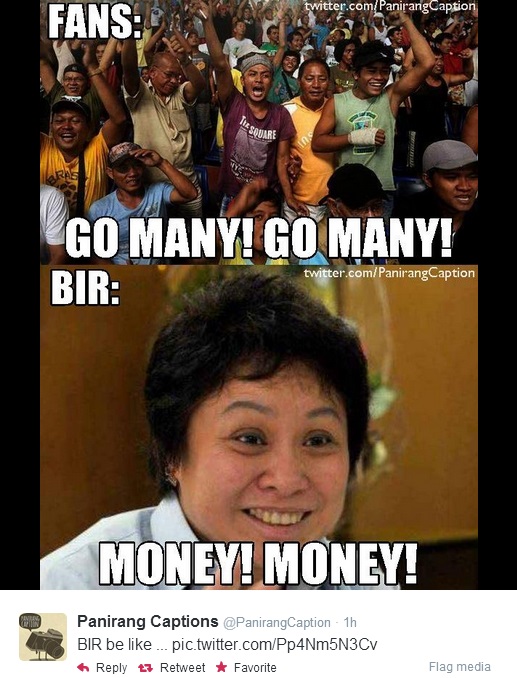
Not to be outdone, Bureau of Internal Revenue (BIR) Commissioner Kim Henares was also given the meme treatment.
One instance is a photograph of Pacquiao’s fans shouting “Manny! Manny!”, coupled with a smirking photo of Henares with the caption “Money! Money!”
 
Pacquiao has been one of the favorite subjects of Henares and the BIR’s tax collection drive.
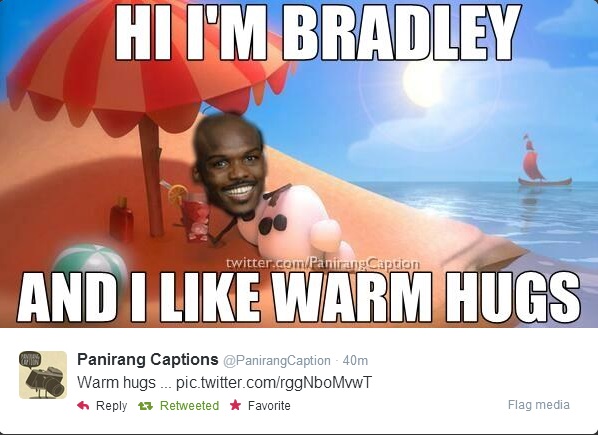
As Pacquiao’s opponent, Bradley also cannot escape the meme treatment.
A “hi I’m Bradley, and I like warm hugs,” meme featured the American boxer’s head plastered on the body of Frozen’s Olaf.
 
It probably alludes to Bradley’s constant clinches with Pacquiao or Mommy Dionisia Pacquiao’s motherly hug with him after the fight.
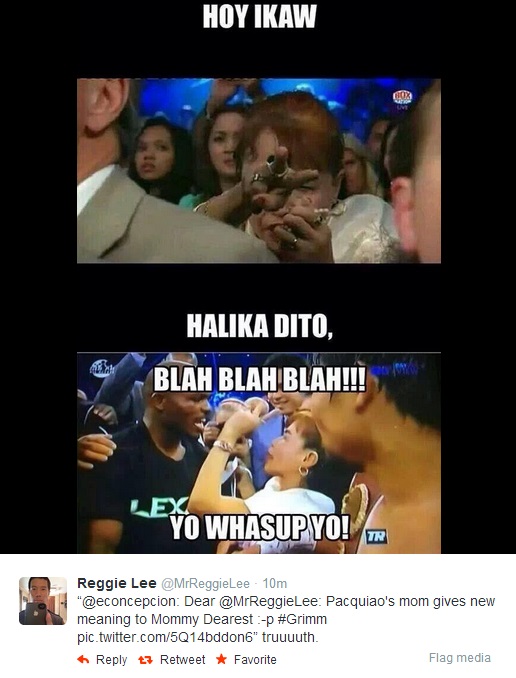
And of course, who could forget the instant internet celebrity that was Pacquiao’s mom or Mommy D?
Just as she ruled the internet and the hearts of international journalists, Mommy D was also “memefied.”
In the meme, after allegedly casting a spell on Bradley during the fight, Mommy D is seen making small talk to her son’s opponent.
 

~Inquirer

Pacquiao wins unanimous decision vs Bradley


LAS VEGAS/MANILA — Revenge was served, and it was cold.
Manny Pacquiao won a 12-round unanimous decision over Timothy Bradley on Saturday to avenge his controversial 2012 loss to the previously unbeaten American.
The Filipino ring icon improved to 56-5 with two drawn and 38 wins inside the distance as he regained the World Boxing Organization welterweight world title he lost to Bradley on June 9, 2012.
Although he couldn’t get his first knockout win since 2009, Pacquiao lived up to his pre-fight promise to come out with more aggression, denying Bradley’s avowed aim of sending him into retirement with another defeat.
“I think I can go another two years,” said Pacquiao, who has won world titles in an unprecedented eight weight divisions. “I’m so happy to be world champion again. Tim Bradley was not an easy fight.”
Bradley, who said he fought from the first round with a right calf injury, fell to 31-1, with 12 knockouts.
“Life goes on,” Bradley said of his first pro defeat. “It’s back to the gym. Not a big deal.”
“You won the fight, you deserved the win,” Bradley said. “I have no excuses.”
After a forgetful 2012, Pacquiao has now picked up two impressive wins in just five months following a dominant victory over Mexican-American Brandon Rios last November at the Venetian in Macau.
Scorecard
Judge Glen Trowbridge scored the bout 118-110 for Pacquiao, while both Michael Pernick and Canada’s Craig Metcalf saw it 116-112 for the ‘Pacman,’ whose every move was cheered by the star-studded crowd of 15,601 at the MGM Grand Garden Arena.
“Bradley is better from the first fight,” Pacquiao said. “He hurt me on the chin. He made adjustments.
“I knew I had to do more this time than I did the last time,” he added.
Pacquiao landed 35 percent of his 563 punches, while Bradley connected with just 22 percent of his 627 blows. Pacquiao’s jab was much more effective, landing 23 percent to Bradley’s measly 11 percent, and the Pacman had a slight edge in landing 148 power punches to Bradley’s 109.
Round by round
Pacquiao’s performance righted one of the biggest perceived wrongs in recent boxing history. Pacquiao was an eight-division world champion on 15-fight winning streak when Bradley was awarded a split decision in their last bout.
Pacquiao was more aggressive and accurate from the opening minutes of the rematch, sticking to trainer Freddie Roach’s pleas to take the action to Bradley. They exchanged big shots in the opening rounds, but Pacquiao appeared to wear out Bradley with the heavy early pace — and the Pacman never slowed down.
Pacquiao landed a series of big left hands in the early rounds, knocking back Bradley with gusto.
Bradley responded impressively in the fourth round, wobbling Pacquiao twice with a right hand.
The pace slowed in the fifth, with Bradley showing off his defense and movement while Pacquiao attempted to trap him against the ropes.
Pacquiao appeared to wobble Bradley late in the seventh round with a vicious combination, but Bradley stood with his back against the ropes and defiantly encouraged it, blocking most of the shots. Bradley appeared to pretend to have wobbly legs at one point after a Pacquiao miss, but his open mouth betrayed his weariness while Pacquiao steadily racked up rounds midway through the fight.
Bradley came on strong in the 12th, and the fighters’ heads collided late in the round. Pacquiao avoided any trouble until the final bell, when he did a short dance step to his corner.
Pacquiao finished the fight with a cut over his left eye. Roach said Pacquiao needed stitches to close the jagged cut.
Old ‘killer instinct’
Saturday’s victory showcased more of the old “killer instinct,” with Bradley saying it was clear that Pacquiao was “going for it”.
But Roach said Bradley’s unexpected strategy of seeking a big knockout blow of his own caught him and Pacquiao by surprise.
“He was swinging for the fences all night,” Roach said of Bradley, who said he thought it was the only way he could win the fight.
But as the pace slowed in the later rounds, Pacquiao dominated, putting together multi-punch combinations that kept Bradley off balance.
“I tried, I really tried,” said Bradley. “I wanted that knockout. I kept trying to throw something over the top, that’s what the plan was.”
But Bradley trainer Joel Diaz said he knew the plan had gone out the window when Bradley came to the corner after the first round saying he thought he had torn his right calf muscle.
Diaz tried massaging it, but Bradley told him to stop because it hurt.
“From that point on, I knew I didn’t have much to work with, because our plan was to dominate Pacquiao and we couldn’t do it,” Diaz said.
The injury was later diagnosed as a strain, and Bradley said he had “no excuses”.
“Manny is a great fighter, one of the best in the world maybe the best ever,” he said.
Before the rematch
While Bradley remains publicly confident he beat Pacquiao in their first bout despite fighting on two injured feet, that much-derided decision sent both fighters’ careers on wild spirals.
The two judges who scored the bout 115-113 for Bradley are no longer in the boxing business, but their decision ended Pacquiao’s 15-fight win streak and forced Bradley to defend himself against widespread criticism of the result.
Bradley endured death threats and depression before returning to the ring in unusually reckless style. He brawled with Ruslan Provodnikov in March 2013 in a sensational unanimous-decision victory that silenced critics of his style and heart. Bradley then outpointed veteran Mexican champion Juan Manuel Marquez last fall, polishing his skills and making himself attractive to Pacquiao for a rematch.
Pacquiao was knocked unconscious by Marquez in the sixth round of their fourth fight in late 2012, and he took nearly a year off before returning for an unspectacular victory over Brandon Rios last fall. Pacquiao’s last two performances prompted Bradley to declare Pacquiao had lost his killer instinct, noting he was unable or unwilling to stop any of his opponents since late 2009.
Pacquiao’s next foe

Pacquiao’s next opponent could be the winner of the May 17 bout between Mike Alvarado and Marquez.
If Marquez wins, he could meet Pacquiao for the fifth time.
“I have no problem with fighting Marquez again, but that’s up to my promoter, Bob Arum,” Pacquiao said.
Motherly love
After the decision was announced, Dionisia Pacquiao, the fighting congressman’s mother, quickly approached the fallen American.
Mommy D, as she is fondly called, was probably the first to console Bradley from the Pacquiao camp, giving the American some motherly hug and a playful jab to the chin.
And Mommy D did not disappoint, claiming the 8th spot on the World’s trending topics on Twitter as of 1:30 p.m. (Manila time).

~Inquirer :)

Love triangle ng mga grade 7, nauwi sa madugong batuhan


Tatlong bata mula sa pampanga ang nahuli ng mga barangay na nagkakagulo matapos mag-reklamo ang isang kapitbahay sa ingay at kaguluhan.

mga grade 7


Ang dahilan umano ng away ay ang love triangle ng mga batang nahuli kabilang ang dalawang lalake at isang batang babae, na pare-parehong Grade 7 sa isang paaralan sa Pampanga.

Ayon sa na-interview na barangay tanod, ang dahilan ng away ay bangayan sa pag-ibig ng mga bata

"Siya po kasi, nilalandi niya pa po. Girlfriend ko po kasi kinuha ko yung phone at kung ano ano tinetext nung lalake"
Sambit ng batang nahuli.

Napuruhan naman ang sinasabing ka-text nung babae at naka-confine ngayon sa St. Lukes matapos may mamuong dugo sa ulo. Hindi padin gumigising ang lalake.

Inaalam pa ngayon kung ano ang aksyong gagawin ng pamilya ng biktima.

'Sloppy' Pacquiao still draws praise from Roach

Manny Pacquiao and trainer Freddie Roach celebrate victory over Timothy Bradley of the US following their WBO World Welterweight Championship title match at the MGM Grand Arena in Las Vegas, Nevada. Photo by Joe Klamar, Agence France-Presse


Hall-of-Fame trainer Freddie Roach is happy with Manny Pacquiao's performance even as he acknowledged that the "Pacman" was somewhat "sloppy" in his unanimous decision win against American Timothy Bradley.
Pacquiao avenged his controversial June 2012 loss to Bradley with a clear-cut decision win in the rematch, outpointing the American over 12 rounds to regain the WBO welterweight championship.
“Manny was a little sloppy tonight,” Roach said, as quoted by ESPN.com. “But I was happy with his performance.”
Bradley clearly buzzed Pacquiao in the fourth round, landing a right that the “Pacman” later admitted hurt him. But Bradley, who wanted to go for a knockout, became a victim of his own aggression, as he opened himself up for Pacquiao’s power punches.
“It looked like Bradley was going for a one-punch home run,” Roach observed.
Bradley later explained that he wanted to “throw something over the top,” such as the wild overhand rights that he kept launching in the second half of the fight. Pacquiao was easily able to spin away from his attacks, however, often while landing multiple-punch combinations of his own.
Yet the “Pacman” was effusive in his praise of Bradley after the fight and refused to talk trash about the American fighter.
“He gave me a good fight. He’s not that easy,” said Pacquiao. “I listened to my corner about keeping my hands up and timing.”
“He threw a lot of punches,” he added. “He threw wide, wide, wide hooks. I got hit one time, and I said it’s not good to be careless.”
Pacquiao slowly but surely took control of the bout from the sixth round onward, and wound up winning a wide points decision, 116-112, 116-112, and 118-110.

Lady, Chiefs eye sweep Bulldogs seek quarter Finals

Arellano, goes for a sweep of Group A against a tough Adamson side while National U tries to seal a spot in the quarters as it battles Far Eastern U in Group B in the Shakey’s V-League Season 11 First Conference at The Arena in San Juan City yesterday.
The Lady Chiefs clinched the first quarters berth with a three-set romp over St. Louis U of Baguio last Tuesday for a 4-0 card with the Legarda-based squad still vowing to go all-out for a win not only to complete a sweep of the elims but also bring that winning feeling into the Last 8 phase.
But the against the Lady Falcons, the Lady Chiefs will be facing a team oozing with confidence following a pair of 3-0 routs over St. Louis and Southwestern U that put it back on track after dropping a 1-3 decision to reigning UAAP champion Ateneo in the inaugurals of the league sponsored by Shakey’s last March 23.
Gametime is at 2 p.m. with action expected to heat up in the league where it all started with Arellano pinning its hopes on Danna Henson, Cristine Joy Rosario, Elaine Sagun, Menchie Tubiera, Shirley Salamagos, Jovielyn Prado and ace setter Angelica Legacion, and Shiela Pineda, Mylene Paat, Jessica Galanza, Thai guest player Pacharee Sangmuang and playmaker May Jennifer Macatuno spearheading Adamson’s charge.
Former ace Pau Soriano is also expected to re-join the Adamson squad after missing the team’s last outing to honor a previous commitment.
A victory by Adamson will net the Lady Falcons the second quarters seat but a loss will revive SLU’s (0-3) slim hopes of forcing a playoff for the last quarterfinal spot in Group A of the two-division tournament backed by Mikasa, Accel and Lion Tiger Mosquito Coil.
NU, meanwhile, tries to formalize its stint in the next round as it shoots for a fourth straight win against FEU in the 4 p.m. main game. The Lady Bulldogs, led by the fancied sister-tandem of Dindin and Jaja Santiago, posted a pair of sweeps and nipped the UST Tigresses in five to zero in on the first quarters seat in Group B.
FEU, on the other hand, beat San Sebastian in four but the Lady Tams, led by Bernadette Pons and Joy Palma, Tony Rose Basas, dropped a four-setter to the UST Tigresses the last time out.
Meanwhile, the NU-SSC tussle last Tuesday will be aired today (Thursday) starting at 1 p.m. on GMA News TV Chaneel with the Arellano-Adamson clash to be aired tomorrow and the NU-FEU duel set to be shown on Monday, according to the organizing Sports Vision.,

PHL's Memorial against China: What it may look like

Last March 30, Foreign Affairs Secretary Alberto del Rosario announced the filing of the Philippines' Memorial in the arbitration proceedings regarding China’s claim to the entire South China Sea. It is a massive undertaking: 10 volumes in all, with 270 pages of legal analysis and argument, supported by more than 3700 pages of documentary evidence. Because of its sensitive nature, no copy was released pending advice from the tribunal. But careful scrutiny of what is known about the document and experiences in other international proceedings can provide us a glimpse into its possible content.

The core of the Memorial is in the first volume, which marshals the facts with the 1982 UN Convention on the Law of the Sea (UNCLOS) and customary international law. It combines analysis with advocacy in order to persuade the tribunal to rule in the Philippines’ favor, and declare China's Nine Dashed Line claim invalid and hold that China should end its illegal occupation of eight rocks and reefs in the West Philippine Sea.

The Memorial faces at least two major hurdles, each of which must be surmounted convincingly in order to persuade the tribunal to rule on the case on the merits. Both impinge on the jurisdiction of the ad hoc tribunal, which was constituted in accordance with Article 286-288 (compulsory procedures in cases of disputes over the interpretation and application of the treaty) and Annex VII (basic procedures for the establishment of arbitral tribunals) of the UNCLOS.

Non-participation of China

First is the absence of China from the proceedings. There are substantive and procedural questions that revolve around whether or not a party that has rejected and does not participate in the arbitration can be bound by its decision.

The international maritime case law on such a situation is still relatively sparse, with only two decided maritime boundary delimitation cases so far: Guyana v. Suriname and Barbados v. Trinidad and Tobago. However, in both cases, the defending party did participate in the proceedings. Suriname contested the tribunal's jurisdiction, but conceded that if  certain facts were established then it could exercise jurisdiction. Trinidad and Tobago, on the other hand, contested jurisdiction but at the same time made counter-claims against the opposing party, which implied that it also accepted jurisdiction. Therefore, the two cases are not directly comparable to the situation of the Philippines-China arbitration, where the defending party has completely refused to participate at all.

However, the Philippines is confident that China's non-appearance and non-participation does not bar the arbitration. An applicant-State's right to unilaterally bring a dispute to arbitration over the defending-State's objections was also expressly recognized in the Barbados case, which means that on this point, the only aspect possibly in favor of China is its total absence from the case.

From a substantial perspective, China’s non-participation brings to the fore the essence of arbitration that distinguishes it from adjudication, that is, there has to be consent from the disputing parties. This presents the Philippines with a possibly trend-setting challenge: It must persuasively argue that the ruling in the Barbados case recognizing the applicant's right to unilaterally bring a dispute to arbitration still holds true despite such absence.

Claim to West Philippine Sea

The second major obstacle is the tribunal's appreciation of the nature and substance of the dispute.

China's most plausible arguments against the arbitration are:
(a) It is an attempt to indirectly secure the Philippines’ claim to the different islands, rocks and reefs in the West Philippine Sea, as the competing claims to sovereignty over them are the actual core of the disputes; and
(b) The Philippines is asking the tribunal to rule on the legal status of China's actions and installations in the West Philippine Sea, which cannot be done unless the tribunal undertakes maritime boundary delimitations to determine who has the right to exercise sovereignty or jurisdiction in the parts of the seabed on which they are located.

These objections are based on conventional practice whenever an international tribunal is asked to determine which coastal State has sovereign rights over portions of their adjacent or opposing seas. Typically, the tribunal must first assure itself of which coastal State has sovereignty over any relevant land masses, measure and project the corresponding maritime zones from them, and in case they overlap, delimit the boundaries between the disputing States, before it can characterize the legality of acts in any specific location.

If the tribunal accepts the Chinese viewpoint, then it will decline jurisdiction over the Philippines' claims.

In the Memorial, the Philippines will attempt to sidestep these defenses by insisting that it does not seek either a determination of sovereignty over the islands, or a delimitation of maritime boundaries. It must show that the conventional practice of international courts does not apply in this case.

Focus on Nine Dashed Lines

However, simply stating that a decision on sovereignty is not sought, or that boundaries need not be delimited, will not be enough: the tribunal needs to be absolutely convinced that these are not necessary to the resolution of the issues under arbitration. These may be addressed by zeroing in on the principal source of the disputes, which is the Nine Dashed Lines.
China's Nine Dashed Lines (magenta) compared with the 200-nautical mile EEZ (light blue) measured from the mainland coasts of the surrounding coastal States. Also shown are the Philippines' archipelagic baselines (red), prospective 12-nautical mile territorial sea (orange), positions in the Kalayaan Island Group, and Bajo de Masinloc (Scarborough Shoal). Map by JAY L. BATONGBACAL

The Nine Dashed Lines represent China's claim to certain amorphous rights – characterized as such because they have not had any clear substantive basis for decades –within a vast expanse of the South China Sea. It is this lack of clarity that has been China's main refuge for attempting to reserve and assert its claims anywhere within this large body of water.

Since 1947, China's diplomatic communications described its claim as sovereignty over the islands and insular features, not the entirety, of the South China Sea. Mainland China never took action to assert this amorphous claim, although Taiwan independently took control of the largest island, Itu Aba. Neither the mainland nor Taiwan explained the basis or substance of the claim, but among Chinese scholars and policy advocates, the explanation of the Nine Dashed Lines is split into four:
  • It represented a claim to sovereignty over only the islands (not waters) within the lines.
  • It was a claim to sovereignty over islands and UNCLOS-based jurisdictions over the enclosed waters.
  • It represented a line of historic rights to fishing.
  • It represented a historic territorial boundary line.

Lack of clarity on the real nature of the Nine Dashed Lines allowed China's actions to be sheltered within the plausible limits of interpretation under UNCLOS. This policy of ambiguity prevailed until sometime around 2008-2009, when China became increasingly assertive in its maritime policies and enforcement activities in the aftermath of the Vietnamese and Malaysian claims to the seabed beyond 200 nautical miles in the South China Sea, in accordance with UNCLOS.

China’s actions inevitably led to conflict, as the Nine Dashed Lines effectively deprived other countries around the South China Sea of their own exclusive economic zones (EEZs) and continental shelf under UNCLOS. Not only did China begin sending its law enforcement vessels to protect Chinese fishing operations inside the EEZs of Vietnam, Indonesia, Malaysia, and the Philippines, it also began actively interfering with their long-standing petroleum exploration activities. Chinese ships cut the seismic exploration cables of Vietnamese survey ships, and threatened the operations of Philippine vessels off Reed Bank. China also protested Philippine petroleum contracts and bidding processes for concession areas on the Philippine continental shelf off Palawan.

These acts were undertaken in places where they could not be justifiable unless China was claiming to exercise absolute sovereignty over the entire area of the Nine Dashed Lines, which was inconsistent with its previous public positions.

China's diplomatic language also increasingly bent toward claiming absolute sovereignty on the basis of history, not international law. However, this flies in the face of both UNCLOS, which establishes the system of maritime zones globally, and customary international law, which has consistently held for hundreds of years that no State can place any portion of the high seas under its sovereignty.
Prospective vs. territorial claim

The basis for China's strength in the past is also its greatest weakness at present: legal ambiguity and coercive action fundamentally create a situation of inequity. The Philippine Memorial may exploit this weakness by impressing upon the tribunal the idea that the Nine Dashed Lines can only be interpreted as a prospective Chinese claim to UNCLOS maritime zones, rather than a territorial claim. This means it can only be appreciated as an attempt to delineate a maximum negotiating position for UNCLOS-based maritime zones, not as a defined boundary, and cannot unilaterally create enforceable rights.

The Philippines could harp on China's lack of clarity as preventing the emergence or recognition of any maritime rights in its favor, and then invoke estoppel by emphasizing Chinese statements that are more susceptible to an interpretation consistent with UNCLOS. Such statements can be used as binding declarations against China’s interest regarding its current expansive claims to the South China Sea.

By binding China to an UNCLOS-based interpretation of the Nine Dashed Lines, the excessive character of the claim and the acts undertaken by China to assert it are clearly demonstrated. Such an interpretation will also test the Nine Dashed Lines against the standards for measurement of maritime zones as defined in UNCLOS, which in turn will determine where China can legitimately lay its claims. It will then enable a proper determination of whether or not historic title, rights, or waters concepts may properly be invoked in China's favor in the South China Sea.

It is expected that the Philippines will question whether or not claims to waters based on history survived the processes of negotiation, ratification, and entry into force of UNCLOS. On this issue, the Philippines definitely has the upper hand, as maritime international scholars agree that expansive claims to marine waters based on history were practically and deliberately eliminated by UNCLOS, save for a few instances applicable only to the internal waters and territorial sea not exceeding 12 nautical miles from shore, and limited recognition of traditional fishing rights in the EEZ.

The necessary proof will probably center on publicly known events, such as China's interference with navigation and seismic survey activities, pressure against Philippine petroleum exploration, and protection of illegal fishing activities well beyond any possible hypothetical EEZ or continental shelf boundary line. China's interference can only be based either on a claim to sovereignty over the area within the Nine Dashed Lines, or a claim to the exercise of sovereign rights (including legislative, regulatory, and enforcement jurisdiction) under international law.

In either case, none of these activities at the periphery of the Nine Dashed Lines can be justified. They would persuasively demonstrate their own excessiveness, even without any possible maritime delimitation. The Philippines can show that there is no plausible delimitation solution for the incidents shown, and therefore, the issues raised cannot be questions of maritime boundary delimitations.

Thus, it may be argued that these are purely questions of application and interpretation of UNCLOS, well within the jurisdiction of the arbitral tribunal.

Questionable Chinese installations

An extensive and successful demolition of the Nine Dashed Lines will undermine China's legal positions with respect to its artificial islands and installations in the West Philippine Sea. These installations are of two kinds:
(a) those established on submerged reefs like Mischief Reef, and
(b) those built on reefs that originally had rocks above water at high tide, like Fiery Cross Reef.

China built structures on reef atolls in order to take advantage of the natural harbor that the reef offers in what would otherwise be open sea. They serve as ideal offshore bases, supply stations, and shelters for all types of vessels.
Close-up of occupied positions in the West Philippine Sea: Chinese installations in red, Philippine positions in blue. The orange squares are Vietnamese positions, while the brown circles represent Malaysian positions. Itu Aba is marked in yellow, just below Philippine-held Kota and Panata Island. Map by JAY L. BATONGBACAL

The Chinese installations on Subi, Gaven, McKennan, and Mischief Reef run afoul of international law because they are obviously artificial islands built on the submerged seabed. International law does not recognize any maritime entitlements arising from such facilities, as submerged reefs are simply part of the seabed or continental shelf. Fiery Cross, Cuarteron, and Johnson Reef are also artificial islands, but the presence of rocks at high tide on those reefs at least establishes a 12-nautical mile territorial sea around them. Scarborough is similarly situated, having several rocks above water at high tide, although occupation and control of the reef is exercised through the stationing of Chinese maritime law enforcement vessels rather than through construction and maintenance of facilities.

The Philippines will argue that by impeding navigation or scaring away Philippine fishing and other resource activities in the areas around these features, China is asserting excessive maritime rights. It can be expected that the Philippines will introduce much technical evidence to prove the nature of these features, and compare them with similar features elsewhere that have already been characterized by courts or arbitral tribunals.

The recently concluded Nicaragua v. Colombia is likely to be invoked by the Philippines, since it dealt squarely with questions of the physical characteristics of rocks and islands and entitlement to maritime zones.  For example, one rock in the Nicaragua case called Quitasueño was only the size of a small closet rising one meter above water at high tide, and generated only a 12-nautical mile territorial sea; it bears a striking resemblance to the rocks in Scarborough Shoal. Since Quitasueño has been adjudged to represent a “rock” under Art. 121(3), then similar features should be similarly classified.

The Memorial will surely include evidence of the acts of China that represent its excessive assertions of sovereignty or rights. These include its interference with Philippine fishing activities and navigation to and from the Kalayaan Island Group, protests against petroleum exploration in the contract areas west of Palawan (including Reed Bank), and possibly its coercive protection of Chinese fishing activities deep inside the Philippine EEZ. News reports are not enough, so the evidence in the annexes will probably include official records, reports, and other documents about these events.

Resolving political geography

One of the greatest and most obvious challenges to getting the tribunal to rule favorably on these claims against the Chinese installations is the legal implication of the presence of other islands and rocks in their vicinity.

As stated in the North Sea Continental Shelf cases, there can be no question of refashioning nature or geography in the determination of maritime entitlements. This will prompt the tribunal to seek full knowledge of the context of the contested features and facilities; once they appreciate the complicated natural and political geography of the area, they will most certainly question whether the location of the Chinese installations are such that they may be within the prospective maritime zones of any other island or rock whose ownership and status of sovereignty may be questioned.

Various such features are present within the vicinity of the Chinese installations. The most notable are the two largest islands – Itu Aba occupied by Taiwan, and Pag-asa Island occupied by the Philippines. Even if a decision on the sovereignty of those islands is not sought, the fact that an installation may be within 12 nautical miles of an island or rock means that the tribunal cannot determine the legal status of the seabed on which the Chinese installation is built, without a ruling on sovereignty and a maritime boundary delimitation.

Thus, the Memorial must persuasively argue that the presence of these adjacent features has no relevance to the determination of the legal status of China's occupation at each location. Extended arguments about each one can be expected, so that the tribunal can make individual determinations.

Jurisdiction in conclusion

Solicitor General Jardeleza, in a recent UP forum, hinted at how the Memorial will end: by tackling the jurisdictional objections in conclusion, not as a preliminary issue. The advantage of this strategy is that the Philippines will have the opportunity to present the case in full, and thus ensure that the merits are heard, before the tribunal decides whether or not it should exercise jurisdiction.

The procedure adopted by the tribunal does not separate the resolution of the issue of jurisdiction from the decision on the merits. The Memorial will likely be similar in structure. This way, it is hoped the tribunal will see the merits of the case and find that regardless of the forms, procedures, and technicalities, there is an undeniable need to dispense justice and establish the basis for fairness in the maritime relations between the Philippines and China. - YA, GMA News

~GMA News

Palace, Binay laud Pacquiao for victory !


MANILA -- (UPDATED) Vice President Jejomar Binay on Sunday lauded boxing icon Manny Pacquiao’s win, saying he showcases the Filipino’s “heart and determination” against challenges.
In a statement, Binay said: “Manny will always be the people's champion. He inspires all of us to push ourselves to greater heights, to always believe in ourselves and in the Almighty and see the limitless possibilities that await us. His victory over Timothy Bradley is certainly a victory to be cherished by all Filipinos.”
Pacquiao’s win is expected to bolster his bid for another elective post in 2016.Binay earlier announced that Pacquiao is expected to run for senator under the United Nationalist Alliance (UNA) banner.
In a separate statement, Communications Secretary Sonny Coloma congratulated Pacquiao for his “magnificent triumph.”
“He embodies the world-class qualities of the Filipino in many competitive fields. We can hold our heads up high by dint of our industry, hard work and courage,” Coloma said, adding that Pacquiao symbolizes Filipinos’ resiliency amid the successive calamities and challenges.
As with all Filipinos, Malacanang is already awaiting the arrival of Pacquiao, Coloma said.
“We will extend the proverbial red carpet when we welcome home Congressman Manny Pacquiao who will certainly be experience the warmth of the unparalleled enthusiasm and abiding affection of nearly 100 million Filipinos,” he said.
In a separate statement, House Speaker Feliciano Belmonte thanked Pacquiao for continuing to be an inspiration to all.
“Manny has once again shown us that focusing on discipline and determination makes no battle insurmountable. At 35, his victory over a much younger Bradley at 30 -- who was said to have been even better trained now than in their previous fight -- has shown the world that he continues to be the pound-for-pound King of Boxing,” Belmonte said.

DOJ , Binasura ang kaso nila Deniece Cornejo At Cedrick Lee Laban Kay Vhong

DOJ  dismissed the rape complaint filed by model Deniece Cornejo against Vhong Navarro today, Thursday April 10.
Deniece Cornejo, in her first complaint-affidavit in the rape case she against Navarro, claimed that Navarro forced her to do oral sex on him, and tried to insert his penis in her vagina on January 22, the night the group of businessman Cedric Lee allegedly came to her rescue the model.

In a counter-affidavit submitted to the DOJ prosecution panel on a later date in February, Cornejo also claimed Navarro first sexually assaulted her when they were together in her Forbeswood Heights condo unit on January 17.

This after her lawyer, Atty. Howard Calleja had told ANC’s “Headstart” in an interview that nothing happened between Cornejo and Navarro on January 17.

Navarro denied all the allegations and claimed that he was a victim of extortion. He said he was blindfolded and tied up before being attacked by at least six men, including Lee.

The actor has since filed six criminal charges against Lee, Cornejo and six others including serious physical injuries, grave threat, grave coercion, unlawful arrest, blackmail, and serious illegal detention, which is a non-bailable offense. (Source: ABS-CBN news)


Sawakas, matapos ang ilang buwan na paulit ulit na pag-labas ni Vhong Navarro na umiiyak dahil sa bugbog na sinapit. Nabasura narin ang kasong isinampa sa kanya ni Deniecec Cornejo, ang babaeng hindi naman niya girlfriend pero pinuntahan niya sa Condo at dinalhan pa ng Foods. Justice served.
 

Most Reading

Tags

Sidebar One